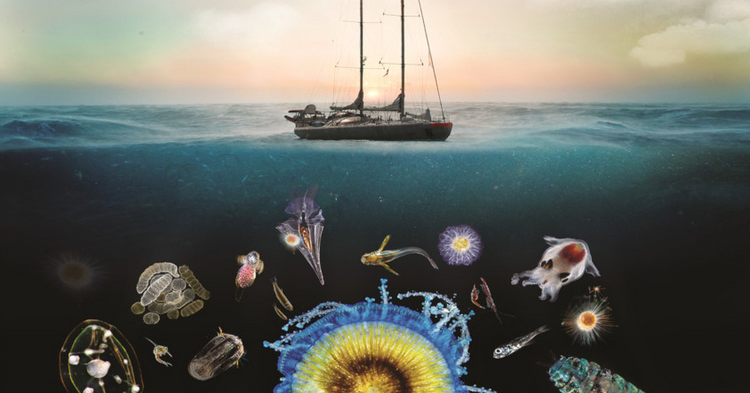
Hi, this is Jasmine and Jade from the DNL club. We are going to introduce you to the Tara expedition, which made incredible scientific discoveries. Their goal was to develop high-resolution sampling of plankton, analyse the samples and generate data to understand them. The scientists of the Tara expedition were interested in plankton because plankton is at the heart of the marine environment. For example, plankton absorbs about 30% of carbon dioxide. Plankton is the key to the food chain because changes in plankton have an impact on larger organisms. We can also use plankton to understand changes in light, temperature, salinity and pH, because plankton is affected by these modifications and reflects them.
They made five major expeditions in different places.
- Tara Arctic (2006–2008): they collected data on the ice, the atmosphere and the ocean.
- Tara Ocean (2009–2013): it was located in the polar circle ocean.
- Tara Mediterranée (2014): it also assessed the impact of microplastics on the health and functioning of ecosystems in the Mediterranean.
- Tara Pacific (2016–2018): it studied coral reefs in the face of global change.
- Tara Microplastics (2019): it travelled along the four European sea fronts to trace the origins of plastic pollution.
Thanks to these expeditions, we discovered a wide variety of plankton. Plankton is divided into two big categories: phytoplankton, which is the microscopic type of plant, and zooplankton, which includes bacteria, viruses and larval stages of larger organisms. With the Tara expedition, we found about 2.87 billion unknown genetic sequences. You may ask: how did they do all of this? It is simple: they use DNA barcoding. A DNA barcode is a small DNA sequence used to identify species. It must be almost identical within one species and very different between species, so they can be clearly distinguished. And now, with this technology, it is easier to study organismal diversity in ecosystems, facilitating community analysis, species discovery and ecological research. They also use PCR to amplify DNA and do better analyses of the DNA samples and to duplicate them, so they can study a big range of species, but also families.
In parallel with these research activities, the Tara Ocean expedition also aimed to raise public awareness of the issues related to climate change. The expedition also mobilised political decision-makers. This project was led by 250 scientists who help the cause and work for change, and it also advances our knowledge of plankton.
Just like the Tara’s expedition, we will go to different watering places around Marseille to harvest water samples and try to study the blue crab larvae, a species that recentrly migrated to the Mediterranean seaside and invaded its lagoons. We will not be using DNA sampling, but the planktoscope we built and and AI program to recognize and study the blue crabs early development stages.
Sources: